
Portable Carbon Dioxide Detectors for Travel: What They Can—and Can’t—Tell You
A portable carbon dioxide (CO₂) detector can help travellers assess ventilation in places such as hotel rooms, hire cars, trains and meeting rooms. Small enough to carry in a bag, it measures the concentration of CO₂ in the air and displays the result, usually in parts per million (ppm).
Used thoughtfully, a CO₂ monitor can offer a useful indication of how well a shared indoor space is ventilated. It is not, however, a general-purpose safety alarm, and it cannot tell you whether the air is free from viruses, toxic gases or other pollutants.
Why monitor CO₂ while travelling?
People breathe out CO₂. In an occupied room with limited fresh-air exchange, the concentration tends to rise. A higher reading can therefore suggest that ventilation may be poor for the number of people in the space. This can be useful when deciding whether to open a window, move outdoors or choose a less crowded area.
For example, a traveller might use a monitor in a busy meeting room, a shared vehicle or a hotel room with little fresh-air supply. Readings are most helpful when viewed over time and considered alongside the number of people present, room size and ventilation arrangements.
Choosing a portable CO₂ monitor
Look for a device that measures actual CO₂ using a non-dispersive infrared (NDIR) sensor. Some low-cost products display an “eCO₂” estimate derived from other sensor readings. These estimates are not the same as a direct CO₂ measurement and may be less useful for assessing ventilation.
Before buying, check the monitor’s:
- Measurement range and accuracy: These should be clearly stated by the manufacturer.
- Battery life and charging method: Consider how long you may be away from a power source.
- Size and display: A clear, easy-to-read screen is useful when checking readings quickly.
- Calibration guidance: Follow the manufacturer’s instructions, as sensor accuracy can drift over time.
- Alarm settings: Treat alerts as prompts to assess the space, not as proof that it is safe or unsafe.
How to interpret the readings
Outdoor CO₂ concentrations are typically a little over 400 ppm, although they vary by location and conditions. In an occupied indoor space, readings below about 800 ppm are often consistent with good ventilation, while readings above 1,000 ppm can suggest that more fresh air may be needed. These are practical indicators, not health limits or guarantees.
A reading depends on factors such as occupancy, room size, activity and air circulation. A brief high reading does not necessarily describe the whole space, and a low reading does not prove that there are no airborne hazards. Allow the monitor time to respond, take readings away from people’s faces and vents, and look for patterns rather than relying on a single number.
Using a monitor in different travel settings
- Hotel rooms: Check the reading after spending some time in the room. If it rises, use available ventilation where practical or ask about a room with better fresh-air provision.
- Cars and hire vehicles: CO₂ can build up in an occupied vehicle, particularly with several passengers. Fresh-air settings may help; recirculation keeps air circulating inside the cabin.
- Trains and coaches: Readings can change as passengers get on and off and as ventilation varies. Use them as one consideration when choosing where to sit, not as a definitive assessment of the whole vehicle.
- Restaurants and meeting rooms: A rising reading may be a reason to seek better-ventilated seating or take a break outside.
Important limitations
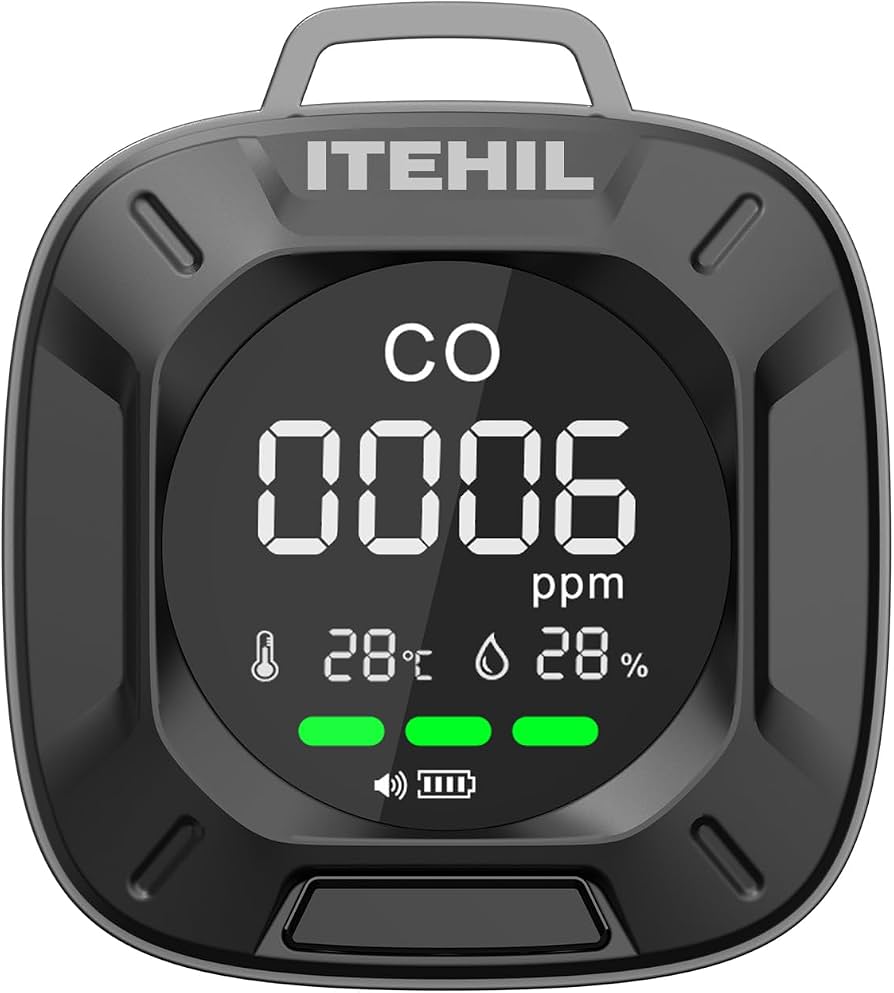
A CO₂ monitor does not detect carbon monoxide (CO). The two gases are different, and a CO₂ device must never be used as a substitute for a carbon monoxide alarm. If travelling with fuel-burning appliances or staying somewhere with a risk of carbon monoxide, use an appropriate certified CO alarm and follow local safety advice.
CO₂ readings also do not measure viruses, mould, smoke, chemical vapours or oxygen levels. Good ventilation can reduce the build-up of exhaled air, but a CO₂ monitor cannot show whether a person is infectious or whether a room is free from infection risk.
Make it part of a wider safety routine
A portable CO₂ detector can help travellers make more informed choices about ventilation, especially in crowded indoor spaces. Choose a genuine CO₂ monitor, learn how to use it and interpret its readings in context. For personal safety, continue to follow venue guidance, use certified alarms where needed and act on symptoms or other warning signs rather than relying on a single device reading.
Top 8 Benefits of Portable Carbon Dioxide Detectors for Travellers
- Compact and easy to pack.
- Helps assess indoor ventilation.
- Provides quick, easy-to-read measurements.
- Useful in hotels and holiday rentals.
- Can help identify stuffy, crowded spaces.
- Supports better-informed travel choices.
- Often rechargeable and reusable.
- Useful in cars, trains and meeting rooms.
Potential Drawbacks of Using Portable Carbon Dioxide Detectors for Travel
- Does not detect carbon monoxide or other dangerous gases.
- Cannot tell whether viruses are present in the air.
- Readings may be inaccurate if the device is poorly calibrated.
- Needs charging or batteries while travelling.
- Can take time to respond to changing conditions.
- A high reading is not a definitive measure of health risk.
- Adds another item to carry and keep track of.
Compact and easy to pack.
A portable carbon dioxide detector is compact and easy to pack, making it a convenient travel companion. Most models fit easily into a handbag, backpack or suitcase without taking up much space, so you can carry one between hotels, hire cars and other indoor settings. Its lightweight design means checking ventilation on the go needn’t add much bulk to your luggage.
Helps assess indoor ventilation.
A portable carbon dioxide detector helps travellers assess indoor ventilation by showing how CO₂ levels change in occupied spaces such as hotel rooms, vehicles and meeting rooms. A rising reading may indicate that fresh air is not circulating well, prompting you to open a window, move to a better-ventilated area or take a break outdoors. It is a useful guide, though not a guarantee of air quality or a detector for viruses and other pollutants.
Provides quick, easy-to-read measurements.
A portable carbon dioxide detector provides quick, easy-to-read measurements, making it simple to check indoor air conditions while travelling. A clear display lets you see CO₂ levels at a glance in places such as hotel rooms, cars and meeting spaces, helping you make informed choices about ventilation without needing specialist knowledge.
Useful in hotels and holiday rentals.
A portable carbon dioxide detector can be useful in hotels and holiday rentals, where ventilation may vary from room to room. Checking the reading can help you spot when CO₂ is building up in an occupied space and consider practical steps, such as opening a window where appropriate, using available ventilation or asking for a better-ventilated room. It offers an indication of ventilation—not a guarantee of air quality or a detector for carbon monoxide.
Can help identify stuffy, crowded spaces.
A portable carbon dioxide detector can help you spot stuffy, crowded spaces while travelling. If CO₂ levels rise, it may indicate that a room or vehicle is poorly ventilated for the number of people inside. This can prompt you to open a window where possible, take a break outdoors or move to a less crowded area. A reading is only an indication of ventilation, not a guarantee that the air is safe.
Supports better-informed travel choices.
A portable carbon dioxide detector can help travellers make better-informed choices about the spaces they use. By showing how CO₂ levels change, it can offer a useful indication of ventilation in places such as hotel rooms, hire cars and crowded indoor venues. Travellers can use this information alongside other factors—such as how busy a space feels and whether fresh air is available—to decide when to open a window, move to a better-ventilated area or take a break outdoors.
Often rechargeable and reusable.
Many portable carbon dioxide detectors are rechargeable and reusable, making them convenient companions for regular travel. Instead of replacing disposable batteries frequently, you can recharge the device between trips or while on the move, helping to reduce battery waste and ongoing costs. Check the manufacturer’s guidance for charging and battery care to keep the detector ready for your next journey.
Useful in cars, trains and meeting rooms.
A portable carbon dioxide detector is handy in cars, trains and meeting rooms, where several people may share a confined space. By showing when CO₂ levels are rising, it can help travellers spot signs of inadequate ventilation and consider practical steps, such as opening a window, selecting a fresh-air setting or moving to a less crowded area.
Does not detect carbon monoxide or other dangerous gases.
A portable carbon dioxide detector measures CO₂ only; it does not detect carbon monoxide (CO) or other potentially dangerous gases. This is an important limitation when travelling, particularly in accommodation or vehicles where fuel-burning appliances may be present. Never rely on a CO₂ monitor as a substitute for a properly certified carbon monoxide alarm, and follow the manufacturer’s guidance for any gas-detection equipment you use.
Cannot tell whether viruses are present in the air.
A portable carbon dioxide detector cannot tell you whether viruses are present in the air. It measures CO₂ levels, which can offer an indication of ventilation, but it does not detect viruses or show whether someone nearby is infectious. A low reading therefore does not guarantee that the air is free from infection risk.
Readings may be inaccurate if the device is poorly calibrated.
A portable CO₂ detector may give misleading readings if it is poorly calibrated or its sensor has drifted over time. This can make a space appear better or less well ventilated than it really is, leading to misplaced confidence or unnecessary concern. Check the manufacturer’s calibration guidance, keep the device maintained and treat its readings as an indication rather than a definitive measure of air quality.
Needs charging or batteries while travelling.
A portable carbon dioxide detector needs a reliable power source, which can be inconvenient when travelling. Its battery may run flat during a long journey or day out, while frequent charging can mean carrying an extra cable, adapter or power bank. If the device uses replaceable batteries, spare batteries add to the luggage and may be difficult to find when needed. Without power, the detector cannot provide readings, so it is worth checking its charge before setting off.
Can take time to respond to changing conditions.
A portable carbon dioxide detector may take a little while to respond when conditions change, so its reading can lag behind what is happening in the space. For example, after moving into a crowded room or opening a window, the display may not immediately reflect the new CO₂ level. Allow the sensor time to stabilise, and avoid making decisions based on a single instant reading.
A high reading is not a definitive measure of health risk.
A high CO₂ reading is not, by itself, a definitive measure of health risk. It may indicate that a space is poorly ventilated for the number of people present, but it does not show whether viruses, carbon monoxide or other harmful pollutants are in the air, nor does a lower reading guarantee that the space is safe. Treat the monitor as a useful guide to ventilation, consider the surroundings and follow relevant safety advice rather than relying on one reading alone.
Adds another item to carry and keep track of.
A portable carbon dioxide detector adds another item to pack, charge and keep track of while travelling. It may take up valuable space in a small bag, and it can be easy to leave behind in a hotel room or lose while moving between destinations.